
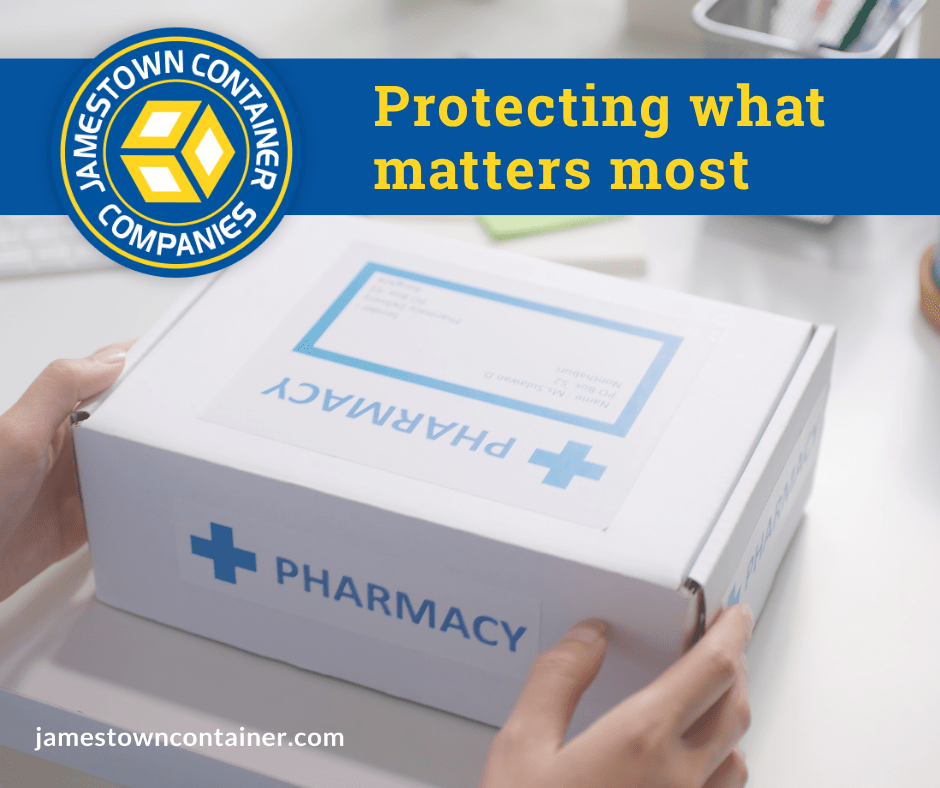
This year is the inaugural World Packaging Day. At Jamestown Container Companies, we are using this celebration to recognize the essential role packaging plays in modern life: protecting products, supporting global commerce, communicating information, and making sure goods reach their destinations safely. That responsibility is doubly important in the healthcare industry.
Medical devices, supplies and pharmaceuticals often travel through complex supply chains with serious regulatory hurdles before they reach the hospitals, pharmacies, clinics, laboratories, or patients’ homes. Along the way, they are handled multiple times, stacked in warehouses, transported long distances, and exposed to sometimes drastically changing environmental conditions. Corrugated packaging provides an important layer of protection through the duration of that journey.
Protection From Production To Point Of Use
Healthcare products are often fragile, sensitive and costly. Diagnostic equipment, surgical instruments, glass containers and other medical devices and products can be vulnerable to impact, vibration and crushing during distribution. A properly designed corrugated package acts as a protective barrier to absorb shock, withstand stacking pressure, and keep products secure throughout transit.
The right packaging solution begins with understanding the product and its journey. Box style, board grade, flute profile, size, and internal protective components can all be customized to the product’s weight, shape, fragility, and storage environment. Custom inserts, partitions, and cushioning can help prevent movement, separate individual items, and protect delicate components from damage.
Protecting these important items is not only about avoiding financial loss. When healthcare products arrive damaged, the consequences can be serious and may cause delayed procedures, interrupted treatment, or lost access to important supplies. Reliable packaging helps ensure essential products are ready when healthcare professionals and patients need them.
Supporting Cleanliness And Product Integrity
Corrugated shipping containers often serve as secondary or tertiary packaging around products that have their own sterile or tamper-evident packaging. Although the corrugated container itself is not typically the sterile barrier, it helps protect that barrier from holes, tears, dirt, and damage during handling, storage, and transportation.
Thoughtful package design can also reduce unnecessary handling and help products remain organized throughout distribution. Clearly printed product identification, handling instructions, lot information, orientation arrows, and other markings enable accurate receiving, inventory management and use. In an industry where traceability and careful handling are essential, the exterior package performs important communication and protective functions.
Designed For Evolving Healthcare Supply Chains
Healthcare distribution has experienced much change over the years. Medical supplies and prescriptions often travel directly to clinics, care facilities and individual homes. These shipments may move through logistics networks that involve frequent handling and a wide range of transportation conditions.
Custom corrugated packaging can be engineered for these specific challenges. Right-sizing your package designs can help limit empty space and reduce product movement, while testing can help determine whether a package is prepared for the anticipated distribution environment. Packaging teams can also collaborate with customers to improve packing efficiency, simplify assembly and create solutions that fit existing production and fulfillment processes.
It’s also important to bear in mind that many medical and healthcare related items are temperature sensitive. Corrugated containers can be utilized to form part of a larger insulated shipping system that includes liners, refrigerants, monitoring devices and other specialized components. Each element must work together to maintain the required conditions and protect the shipment.
Protection With Sustainability In Mind
The healthcare industry requires packaging that performs reliably, but organizations are also looking for ways to reduce waste and use materials responsibly. Corrugated packaging can help balance these priorities.
Corrugated is widely recyclable and package designs can be optimized to use material efficiently without sacrificing performance. Right-sizing can reduce excess material, improve pallet utilization and help lower the space required for storage and transportation. Fiber-based inserts and partitions may also replace less recyclable protective materials in some applications, depending on the product and its performance requirements.
The most sustainable package, however, must protect the product. Damage and reshipment create waste, alongside unseen waste, including the energy, materials, and transportation used to produce and deliver it. Effective packaging contributes to waste reduction across the full supply chain by helping medical products arrive safely intact.
Recognizing Packaging’s Important Role
World Packaging Day is an opportunity to recognize the work that often happens behind the scenes. Designers, manufacturers, quality teams, logistics professionals, and healthcare organizations all contribute to packaging systems that protect products and keep supply chains moving.
Jamestown Container Companies understands that every medical device, pharmaceutical product and healthcare supply item has an important purpose beyond the package. That is why we approach packaging as more than a container, but an important part of delivering products safely, efficiently, and responsibly to the people who depend on them.