
World Packaging Day is an opportunity to recognize the important role packaging plays in protecting products, supporting supply chains and improving everyday life. When it comes to food, effective packaging does more than make products easier to store, transport or display. It can help prevent food waste before it even begins.
Food often travels through multiple environments on its way from a farm or production facility to a grocery store, restaurant or consumer’s home. It is packed, stacked, stored, loaded, transported, unloaded and handled, often several times. At every step, physical damage, poor airflow, unstable stacking or exposure to contaminants can make food unsellable or unusable.
That is why food waste prevention must begin at the start of the supply chain. Well-designed corrugated packaging helps food survive the journey, extending its usable life and increasing the likelihood that it reaches its destination in good condition. Simply put: less damage means less waste.
Protecting Food From Physical Damage
Fresh produce, packaged foods, bottled products and other goods can be vulnerable to crushing, bruising, punctures and other damage during handling and transportation. A corrugated container provides a structural barrier around those products, helping to absorb shocks and resist any pressure created when stacking.
Effective protection begins with designing packaging around the product. The appropriate box style, board strength, flute profile and dimensions depend on factors such as product weight, fragility, moisture exposure, stacking requirements and the expected distribution environment. Internal partitions, pads and other corrugated components can also help separate products, limit movement and reduce product-to-product contact.
Without sufficient protection, one crushed corner or unstable load can damage more than a single item. It can affect an entire case and even adjacent cases on a pallet. Preventing that kind of damage helps to keep more food in the supply chain and out of the landfill.
Maintaining Airflow and Ventilation
Fruits, vegetables and other perishable foods often require airflow to preserve quality. Corrugated packaging for produce can be designed with strategically placed ventilation openings that allow air to circulate through the container and around the product.
Proper ventilation can support cooling and help prevent heat from remaining trapped inside the package. The size and placement of openings must be carefully considered, however. Too few vents may restrict airflow, while too many (or openings placed in the wrong areas) may weaken the package’s structure.
Packaging designers must work to balance ventilation with strength so a container can support both product freshness and the physical demands of storage and distribution.
Improving Stacking, Storage and Transportation
Corrugated packaging is designed not only to hold food, but also to move efficiently through supply chains. Consistent dimensions and well-engineered containers can improve pallet stability, evenly distribute weight and make better use of available space in warehouses and transportation vehicles.
A stable pallet is less likely to shift, lean or collapse during handling and transit. This reduces the risk of crushed packages, fallen cases and damaged food. Rightsized packaging can also limit excess space inside a container, helping prevent products from moving or colliding while in transit.
Efficient packaging and pallet design can have benefits beyond product protection, too. Better use of storage and trailer space may reduce the number of loads needed to move the same amount of food, enabling a more efficient supply chain.
Reducing Exposure and Contamination Risks
Corrugated packaging creates a barrier between food products and the surrounding distribution environment. Depending on the application, it can help shield primary packages or unpackaged produce from dust, dirt and contact during storage and handling.
Box closures, liners, dividers and other components may provide additional protection based on the product’s needs. Printed handling instructions can also communicate important information about orientation, temperature requirements, stacking limits or other precautions, helping supply chain partners handle products correctly.
Packaging is only one part of a comprehensive food safety system, but its protective and communication functions can help preserve the integrity of food as it makes its way to its destination.
Designing Packaging for the Product and Its Journey
There is no single corrugated package that is right for every food product. Fresh produce, frozen foods, canned goods, beverages and shelf-stable products each face different challenges. Even the same product may require a different solution depending on whether it travels through a local delivery network, a refrigerated supply chain, a traditional retail system or an e-commerce network.
Successful packaging design considers the entire journey. That includes packing operations, storage conditions, pallet patterns, transportation methods, handling points and the needs of the final customer. Testing can also help confirm whether a package is prepared for anticipated conditions before it enters the supply chain.
This product-specific approach helps avoid both underpackaging, which may lead to damage, and unnecessary packaging that adds material without improving performance.
Packaging as Part of the Food Waste Solution
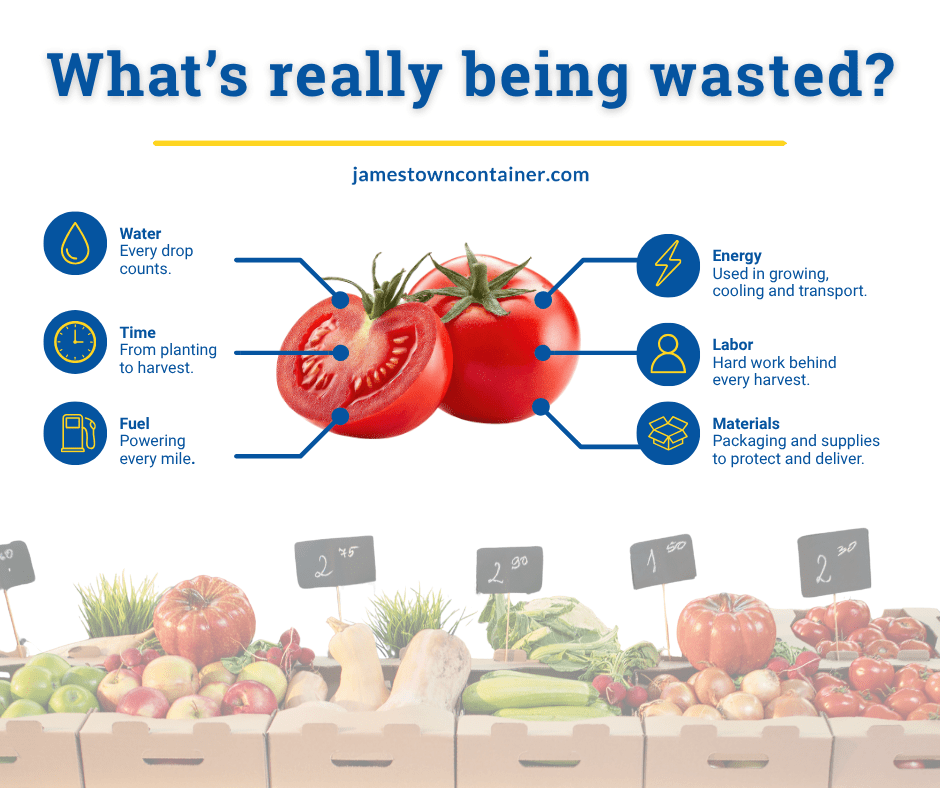
Food waste represents more than the loss of the food itself. When food is discarded, the water, energy, labor, land, materials and transportation used to produce and deliver it are also wasted. Protecting food through the supply chain helps preserve those resources as well.
Corrugated packaging is widely recyclable, can incorporate recycled fiber and can be optimized to provide the necessary protection while using material efficiently. Most importantly, it performs the fundamental sustainability function of helping the product reach its destination intact.
At Jamestown Container Companies, we believe effective packaging starts with understanding what the product needs to not only survive its journey but arrive fresh and ready for its intended use. Through thoughtful design, material selection and collaboration, corrugated packaging can help food producers and distributors reduce damage, improve efficiency and keep more food where it belongs: available for people to use and enjoy.
On World Packaging Day, we celebrate packaging’s often-unseen contribution to the food supply chain. From the first packed case to the final delivery, every prevented bruise, broken container and crushed box represents food and resources that did not go to waste.